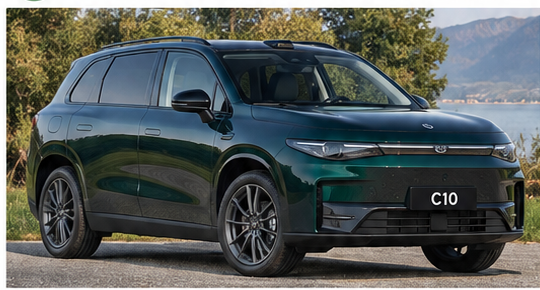
Industry Insight The C10 is becoming more useful as a used-EV benchmark because supply is no longer limited to launch cars. In Germany, AutoScout24 reported roughly 238 C10 offers in September 2026, with a meaningful spread between 2025 and 2026 registrations. Its data showed 2025 cars clustered around the low-€31,000 range while newer 2026 vehicles carried materially higher asking prices. That spread illustrates a normalisation phase for a relatively young EV brand. Buyers are beginning to separate cars by first registration, mileage and powertrain rather than treating every C10 as equivalent. The model’s 69.9 kWh BEV version combines 218 hp with roughly 420 km WLTP range, a large cabin and family-SUV dimensions. Those characteristics give it broader used-market appeal than the T03, especially for drivers replacing internal-combustion crossovers. Valuation is becoming more complex because the C10 nameplate now covers both full-electric and range-extender versions in Europe. A listing described only as “C10” can therefore hide major differences in battery size, fuel type, charging behaviour, taxation and buyer profile. Dealers and exporters should verify the exact powertrain and homologation data before comparing prices. What this means for used-EV buyers and exporters: The C10 is developing into a mainstream used family-EV proposition rather than a niche Chinese import. The most saleable stock should be clearly specified BEV or REEV units with documented service history, battery condition, remaining warranty and transparent VAT status. For cross-border resale, powertrain identification and local charging expectations are now as important as headline mileage.
Insights
Leapmotor C10: A Broader European Used Market Is Forming Around the Family SUV
A wider‑scale used‑vehicle market is taking shape in Europe for the Leapmotor C10 family SUV.